A side-by-side look at fees, ATM access, direct deposit timing, and account style
If you want an app-first way to manage your money, you have probably seen both Chime and Netspend. They are not the same type of service, though. Chime is a financial technology company, not a bank, and its banking services are provided by partner banks.[1] NetSpend is best known for prepaid cards and debit account options offered through issuing banks.[N1]
This comparison focuses on practical details that affect daily use, such as which fees may apply, how cash access works, and what you need to use key features. By the end, you should know which option best matches your habits.
Best fit, in plain terms
- The Chime: Often fits people who use direct deposit, prefer an app-first setup, and want to avoid common account fees. Some benefits depend on eligibility rules, so it is important to read the terms.[2][4]
- The Netspend: Often fits people who want prepaid-style flexibility and an optional overdraft service with a short grace period, rather than a standard bank checking account setup. Fees and features can vary by card and program, so you should check the exact terms of your card before you apply.[N2]
- A side-by-side look at fees, ATM access, direct deposit timing, and account style
- Netspend vs. Chime comparison table
- About the companies
- The advantages: Netspend vs Chime
- What are the disadvantages?
- Other important features
- Ratings and reviews
- Bottom line
- Similar offers and alternatives
- Frequently asked questions
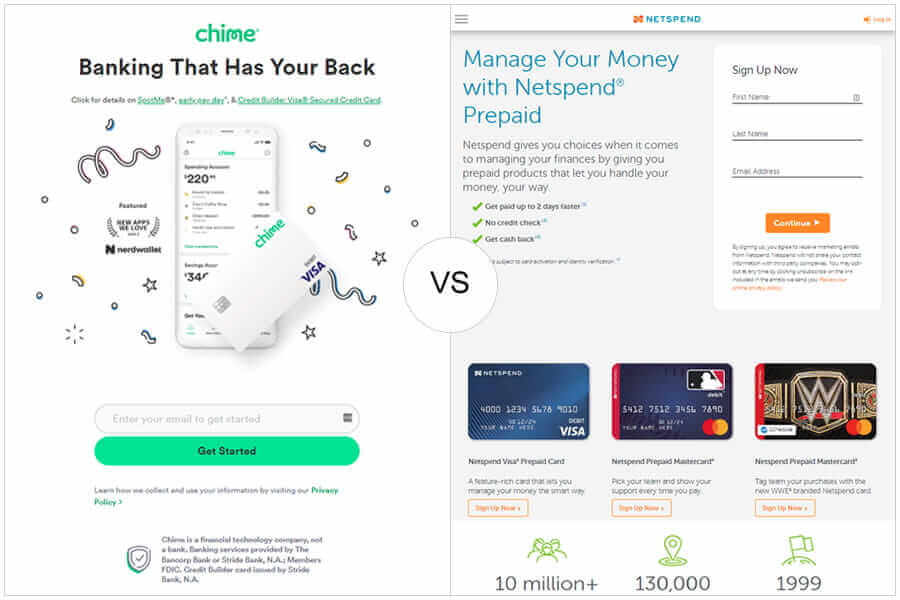
Netspend vs. Chime comparison table
A fast way to choose is to compare how each option works day to day: account type, typical fees, direct deposit timing, ATM access, and cash reload options. Some details can vary by product, card type, and program. Use this table as a starting point, then check the terms before you apply.
| Chime | Netspend | |
|---|---|---|
| What it is | Financial technology company (not a bank) offering app-based accounts through partner banks | Prepaid card and debit account options offered through issuing banks |
| Main account style | Checking account + optional savings + secured credit card option | Prepaid card options and debit account options (features can vary by card/program) |
| Issuer banks | The Bancorp Bank, N.A. or Stride Bank, N.A. (Members FDIC) | Pathward, N.A. and Republic Bank & Trust Company (Members FDIC) |
| Card type | Visa debit card | Visa or Mastercard prepaid (depends on product) |
| Savings | Optional savings account (APY is variable and can change) | Savings option available on some programs (APY is variable and can change) |
| Fees overview | No monthly fees and no minimum balance fees; some optional services/transactions may have fees | Fees depend on plan and product; monthly plan and per-transaction fees can apply |
| Foreign transactions | Varies by transaction type and network rules; check terms | Foreign transaction fees can apply depending on the product/plan |
| Direct deposit “early pay” | Up to 2 days early with direct deposit; timing depends on the payer | Marketing can vary by product; some direct deposit timing claims can differ by program |
| ATM access | Over 47,000 in-network fee-free ATMs; out-of-network and OTC advance fees can apply in some cases | ATM fees can apply depending on product/plan; out-of-network ATM owner fees can also apply |
| Overdraft-style feature | SpotMe is optional; limits range $20-$200; eligibility rules apply | Optional overdraft service may be available depending on product/plan; terms apply |
| Best for | People paid by direct deposit who want an app-first setup and fewer common fees | People who prefer prepaid-style flexibility and want multiple plan choices |
| Not ideal for | People who need branches or want every product in one place | People who want predictable fees without reading a fee schedule closely |
| Claim this offer | Claim this offer |
About the companies
Before we get into an in-depth analysis of the pros and cons you can find at Chime and Netspend, let’s first say something about what they’re all about.
Chime is a financial technology company that offers app-based accounts through partner banks. It focuses on everyday tools such as spending tracking, card controls, direct deposit, and an optional savings account. Some features depend on eligibility rules, and some optional services can have fees, so the terms matter.
NetSpend is best known for prepaid cards and debit account options offered through issuing banks. Depending on the product and plan you choose, you may see monthly plan fees or per-transaction fees, plus optional add-ons. That flexibility can help some people, but it also means you should read the fee schedule for the exact card you pick.
The advantages: Netspend vs Chime
Chime pros
- No monthly fees and no minimum balance fees (common fee avoidance)
- Up to 2 days early direct deposit (timing depends on the payer)
- Over 47,000 in-network fee-free ATMs (exceptions apply)
- Optional SpotMe feature for eligible members (limits and rules apply)
- Savings tools like Round Ups and automatic savings (when available)
Netspend pros
- Multiple prepaid and debit account options (pick a plan that matches your habits)
- A savings option is available on some products (the rate is variable and can change)
- Optional overdraft service may be available, depending on the product /plan
- Cash reload options can be convenient through participating locations (terms/fees vary by location and product)
What are the disadvantages?
Both options have upsides, but neither is perfect. The main differences show up in how you add cash, how support works, and which fees may apply.
Chime cons
- Cash deposits may depend on the third-party location, and third-party fees may apply.
- Some features depend on eligibility rules (for example, certain tools work best with direct deposit).
- No physical branches for in-person help.
- Some people report slower support during busy times, especially for complex issues.
Netspend cons
- Fees can vary by plan and product, and monthly or per-transaction charges may apply.
- ATM and reload fees can vary depending on where and how you use the card.
- Optional overdraft-style features can come with terms and charges, so you must read the specific program rules.
- Some prepaid-style accounts may charge inactivity fees, depending on the plan.
Other important features
If the pros and cons still feel close, focus on how you will use the account each week.
Chime highlights
- On-the-go access: You can manage most tasks in the app, which is helpful if you prefer phone-first money tools.
- Everyday controls: Alerts, balance tracking, and card controls can help you spot problems sooner.
Netspend highlights
- Rewards and offers: Some programs include rewards or offers, but they can vary by card and plan.
- Card options: Netspend offers different card types and styles, so people can pick what fits their habits.
Ratings and reviews
Ratings change often and can vary by app store, site, and time period. Instead of relying on a single score, read a mix of recent reviews and look for recurring themes like fee surprises, support speed, and account holds. Then compare those themes to how you plan to use the account.
Bottom line
Choose based on your habits.
If you use direct deposit, want an app-first setup, and want to avoid common account fees, Chime often fits better. Still, some features have eligibility rules and some optional services can have fees, so read the terms before you apply.
If you want prepaid-style flexibility and plan choices, Netspend can fit the bill. However, fees and features can vary by card and plan, so the best move is to pick the exact product first and read its fee schedule and terms.
Similar offers and alternatives
| Offer | Type | Why people consider it | Best for | Review | Application |
|---|---|---|---|---|---|
| Grow Credit | Credit-building tool | Helps build credit history (see terms) | Credit building without a traditional credit card | Claim this offer | |
| GoHenry | Kids debit card | Parent controls and learning tools (see terms) | Family money basics | Claim this offer | |
| Aspiration | Spend and save account | Values-based features (see terms) | People who want a values-based option | Aspiration Review | Claim this offer |
| SoFi Money | Cash management | App-first money tools (see terms) | One app for spending and saving | Claim this offer | |
| Ramp | Business card | Business controls and reporting (see terms) | Businesses managing spend | Claim this offer | |
| Chase Ink Business Cash | Business card | Business rewards (see terms) | Small business spending | Ink Cards Review | Claim this offer |
| Upgrade Triple Cash | Rewards card | Cash-back style rewards (see terms) | Everyday spending rewards | Upgrade Review | Claim this offer |
Frequently asked questions
Disclosures and Terms (Chime)
[1] Chime is a financial technology company, not a bank. Banking services provided by The Bancorp Bank, N.A., or Stride Bank, N.A., Members FDIC. The Chime Visa Debit Card is issued by The Bancorp Bank, N.A. or Stride Bank, N.A. pursuant to a license from Visa U.S.A. Inc. and may be used everywhere Visa debit cards are accepted. Please see the back of your card for its issuing bank.
[2] Some optional services and some transaction types may have fees or charges (for example, outbound instant transfers, out-of-network transactions, and credit products). Full fee details: chime.com/feesinfo
[3] SpotMe eligibility requirements and limits apply. Overdraft only applies to debit and credit card transactions and cash withdrawals. The limits range from $20 to $200. Chime Checking Account required.
[4] Early access to direct deposit funds depends on when the payer submits the payment file. We generally make these funds available on the day the payment file is received, which may be up to 2 days earlier than the scheduled payment date.
[5] A Chime Checking Account is required to be eligible for a Savings Account. The Annual Percentage Yield (APY) for the savings account is variable and may change at any time. Must have $0.01 in savings to earn interest. Chime+ eligibility can affect rates and benefits; review Chime+ terms for details: chime.com/chime-plus
[6] Out-of-network ATM withdrawal and over-the-counter advance fees may apply, except at MoneyPass ATMs in 7-Eleven stores or at any Allpoint or Visa Plus Alliance ATM. ATM details: chime.com/online-banking/atms
Disclosures and Terms (NetSpend)
[N1] Netspend products are offered through issuing banks and program partners, and availability, terms, and features can vary by product and plan. Official fee schedules and disclosures: netspend.com/fees
[N2] Load limits, direct deposit limits, and other account limits can vary by product, verification level, and program rules, and they may change. Check the terms for your specific card and plan: netspend.com/help
[N3] If an overdraft-style service is available on a Netspend program, it is optional and has specific rules and charges. Review the overdraft protection details for your product: netspend.com/benefits/overdraft-protection
[N4] ATM costs can include both program fees and fees charged by the ATM owner, depending on where you withdraw and which plan you use. See the fee schedule for your product: netspend.com/fees
[N5] Savings, when available, can have an APY that is variable and can change. Current savings terms: netspend.com/savings-account
[N6] Rewards and offers (when available) can vary by program and card type and may change over time. Main site: netspend.com