Compare the two paths to building credit: a card-style option vs a credit-builder plan, plus costs, limits, and who each fits best
Building credit can feel confusing because different products work in different ways. Self is built around a credit-builder plan that helps you build payment history while you save money over time. Chime offers a secured credit card option that can help build credit history through responsible use, but results can vary.[1]
In this guide, we will compare how each option works, what you pay for, what you need to qualify, and which choice makes more sense based on your habits. The goal is simple: pick the option you can follow month after month without stress.
Quick fit guide
- Chime Offer: Often fits people who want a card-style option managed in an app and plan to use direct deposit. Some features have eligibility rules and some optional services may have fees, so read the terms before you rely on a benefit.[2]
- Self Offer: Often fits people who want a structured plan that combines credit building with saving money over time. Fees can apply depending on the plan you choose, so check the pricing before you start.[S1]
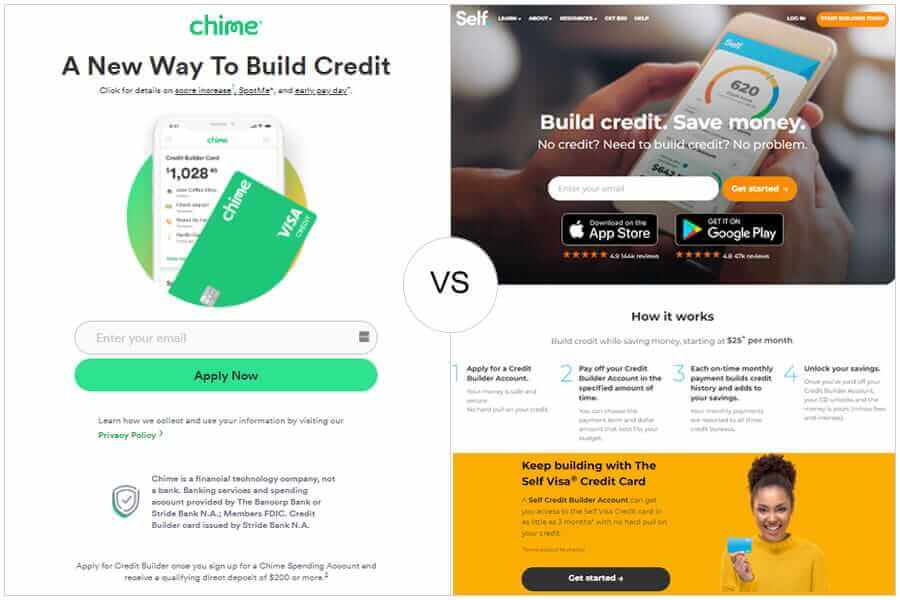
Chime vs Self: side-by-side comparison
| Row | Chime (credit builder option) | Self (credit builder plan + secured card option) |
|---|---|---|
| What it is | App-based checking account + secured credit card option (Chime Card). Chime is a financial technology company, not a bank. | Credit-builder plan (loan held in a CD) and a secured credit card option tied to eligibility. |
| How credit building happens | Card-style use plus on-time payments can help build credit history (results vary). | Monthly payments on the credit-builder plan can help build payment history; the secured card can be a second step (results vary). |
| Issuer/partner banks | Banking services are provided by The Bancorp Bank, N.A. or Stride Bank N.A. (Members FDIC). | Credit Builder Account is held at partner banks (Self lists Sunrise Banks N.A., Lead Bank, SouthState Bank N.A., or First Century Bank, N.A., Members FDIC). The secured card is issued by Lead Bank or First Century Bank, N.A. |
| Typical fees | No monthly fees and no minimum balance fees for the checking account, but some optional services and some transactions may have fees. | Pricing depends on the plan you pick. The secured card has a $25 annual fee (charged once every 12 months). |
| Deposit/funding style | Uses funds you set aside through your account setup. | You start after you pick a plan and set up payments. The secured card option may be available later, depending on the eligibility steps. |
| How fast can you start | You can usually start once your account is set up and you have funds available. Some features depend on eligibility rules and account activity. | You start after you pick a plan and set up payments. The secured card option may come later, depending on eligibility steps. |
| What to watch for | Keep spending small, pay on time, and watch for optional-service fees and eligibility rules. | Plan fees and the $25 annual card fee can add up over time. Plan payments are locked until the plan ends, so only pick a monthly amount you can keep up with. |
| Best for | People who want a card-style option managed in an app and already plan to use an app-first account setup. | People who want a structured monthly plan and do well with “set it and follow it.” |
| Not ideal for | People who need in-person branches or want rewards and a larger credit line. | People who dislike monthly commitments, want rewards, or want to avoid an annual card fee. |
| Claim this Offer | Claim this Offer |
What is Chime Credit Builder?
Chime is a financial technology company that offers an app-first account setup with a checking account, an optional savings account, and a secured credit card option (Chime Card). It is not a bank. Banking services are provided by partner banks.[1] People usually consider it when they want simple account tools, card controls, and a credit-builder-style option in one place.
Quick pros and cons
| Pros | Cons |
|---|---|
| App-first setup with alerts and card controls Savings tools like Round Ups and automatic savings (when available) Optional SpotMe feature for eligible members (limits and rules apply)[3] | No physical branches for in-person support Some features depend on eligibility rules and account activity Some optional services and some transaction types may have fees[2] |
Checking account (Spending Account)
The checking account has no monthly fees and no minimum balance fees.[2] With direct deposit, you may be able to get paid up to 2 days early, but timing depends on when your payer sends the payment file.[4]
SpotMe is optional, and eligibility requirements apply. It may allow certain card purchases and cash withdrawals to go through even if your available balance is short. Limits range from $20 to $200.[3]
Savings account
The savings account is optional, and a checking account is required to be eligible.[5] The APY is variable and can change at any time. Savings tools like Round Ups and automatic transfers can help people save in small steps without having to think about it every day.[5]
Two common ways people use it:
- Round Ups: moves spare change from eligible purchases into savings
- Automatic transfers: move part of each deposit into savings (when set up)
Credit builder card option (Chime Card)
Chime Card is a secured credit card option that can help build credit history when used responsibly. Results can vary, and the safest approach is to keep spending small and pay on time.[1]
Tip: If you are focused on credit building, avoid big spending swings and do not miss payments. Steady, boring habits usually work best.
What is Self Credit Builder?
Self is best known for its credit-builder plan, which helps you build your payment history by setting money aside over time. Instead of giving you a loan cash up front, your monthly payments build toward a certificate of deposit (CD) held at a partner bank, and you get most of that money back at the end after fees and interest.[Self terms]
This approach can work well if you want structure. However, you need to make the payments on time and be comfortable with the fact that the money is not fully available until the plan ends.
Quick pros and cons
| Pros | Cons |
|---|---|
| A structured monthly plan that can build payment history over time You build savings progress while you pay A secured card option may be available after you meet eligibility rules (not guaranteed) | Your savings progress is locked until the plan ends, unless you close early Fees apply based on the plan, and the secured card has an annual fee If you close early, you may give up part of the benefit of the full payment-history timeline |
Self Credit Builder Account
You link a bank account and make monthly payments (many people use autopay). Those payments go into a CD at a partner bank and help build your payment history over the plan term. If you close early, you may face a small early withdrawal penalty, depending on the plan size and timing.[Self terms]
Credit Builder plan (CD-backed installment loan)
Think of it as an installment loan designed for credit building, where the loan funds are held in a CD until you finish. You do not need a large upfront deposit, but you do need to commit to monthly payments. This can be a good fit for people who want a clear, step-by-step path instead of an open-ended card.
Self Visa secured card option
The Self may offer a secured Visa card after you meet minimum eligibility requirements, such as having an active credit-builder account in good standing, building at least $100 in savings progress, and showing a history of on-time payments. Meeting the minimum requirements does not guarantee you will get the card. The secured card has a $25 annual fee (charged once every 12 months). For exact card terms and your eligibility path, check the Self app and official terms.[Self terms]
Chime vs Self in one minute
If you want the simplest way to choose, start with how you prefer to build credit.
- Pick Chime if you want a card-style option you can use for normal spending and manage in one app. This path depends more on daily habits: small purchases, steady use, and on-time payments. Results can vary. (Try Chime, Now!)
- Pick Self if you want a structured monthly plan that builds payment history while you save money over time. This path depends more on consistency: you commit to a plan and keep paying until the term ends. (Try Self, Now!)
If you are unsure, ask yourself one question: do you want a tool you use every week (card-style), or a plan you follow each month (credit-builder plan)?
Alternatives and competing offers
| Name | Product type | Issuer | Best for | Notes | Application |
|---|---|---|---|---|---|
| OakStone Gold Secured | Secured card | Synovus Bank | Basic secured card setup | Confirm deposit and fees | – |
| Sable ONE Secured | Secured card | Coastal Community Bank | App-first secured card | Check current eligibility rules | Apply Now |
| Cleo Credit Builder Card | Credit builder card | Webbank | Credit builder style card | Confirm program terms | – |
| OpenSky Secured Visa | Secured card | Capital Bank, N.A. | Simple secured card | Review fees before applying | Apply Now |
| First Progress Platinum Elite | Secured card | Synovus Bank | Secured card choice | Confirm fee schedule | Apply Now |
| PCB Secured Visa | Secured card | Plains Commerce Bank | Secured card option | Confirm availability by state | – |
| Surge Secured Mastercard | Secured card | Celtic Bank | Secured card option | Often fee-heavy, read terms | Apply Now |
| GO2bank Secured Visa | Secured card | Green Dot Bank | App-first secured card | Confirm cash deposit rules | Apply Now |
RELATED: Best Credit Builder Apps
Final take: which path makes sense
If you want a card-style option for everyday spending and to manage in one app, Chime can be a better fit. It is built around app controls and simple money tools, and it can support credit building through steady, responsible use. Results can vary.
If you want a structured plan that turns monthly payments into savings progress over time, Self can be the better fit. It is often easier for people who like a clear schedule and want a guided path.
Either way, the best choice is the one you can stick with. Credit building is rarely fast, but consistency pays off.
Frequently Asked Questions
Disclosures and Terms (Chime)
[C1] Chime is a financial technology company, not a bank. Banking services provided by The Bancorp Bank, N.A., or Stride Bank, N.A., Members FDIC. The Chime Visa Debit Card and secured Chime Visa credit cards are issued by The Bancorp Bank, N.A, or Stride Bank, N.A., pursuant to a license from Visa U.S.A. Inc. and may be used everywhere Visa debit or credit cards are accepted. Please see the back of your Card for its issuing bank.
[C2] Optional services and products may have fees or charges (for example, outbound instant transfers, out-of-network transactions, and credit products). Fee details: chime.com/feesinfo
[C3] Chime says it does not report card utilization or a preset credit limit for the Chime Card.
[C4] On-time payment history can have a positive impact on your credit score, and late payments may negatively impact your credit score. Impact can vary.
[C5] Early access to direct deposit funds depends on the timing of the submission of the payment file from the payer. We generally make these funds available on the day the payment file is received, which may be up to 2 days earlier than the scheduled payment date.
[C6] Out-of-network ATM withdrawal and over-the-counter advance fees may apply except at MoneyPass ATMs in a 7-Eleven, or any Allpoint or Visa Plus Alliance ATM. ATM details: chime.com/online-banking/atms
Disclosures and Terms (Self)
[S1] Self offers credit-builder plans designed to help build credit history through on-time payments, and may offer a secured card option depending on eligibility. Terms, fees, and eligibility rules apply. Product overview: self.inc/visa-secured-credit-card
[S2] Self Credit Builder Account funds are placed into a certificate of deposit (CD) at a partner bank and are generally not available for withdrawal until the plan is completed (closing early may reduce proceeds).
[S3] The Self Visa secured card annual fee is $25 (charged once every 12 months).
[S4] Reviews and Self materials commonly state there is no hard credit check for the secured Self Visa card, though verification steps may still occur. Confirm details during application.